
Food from the Hmong transports the diner to a land and traditions that seem far away and very forgotten. However, after the Hmong diaspora in the 1970s, many families settled here n the Central Valley of California. I discovered my local produce stand is run by a wonderful Hmong couple.
Below is a recipe or two sampled from Hmong culture. "Simple, earthy, fiery, and fresh, Hmong food is an exciting but still little-known Southeast Asian cuisine" states http://www.hmongcooking.com/home/index.php.

The Cooking from the Heart cookbook has recipes such as Nqaij Qaib Hau Xyaw Tshuaj (Chicken Soup for New Mothers) and Dib Iab Ntim Nqaij Hau Ua Kua (Stuffed Bitter Melon Soup). Give them a try.

Hmong Translation-
Ua tsaug koj tuaj ntsib wb rau ntawm wb phab Web Site. Xav qhia rau koj txog wb phau ntawm yuav tawm tshiab rau tom ntej no, Cooking from the Heart-The Hmong Kitchen in America (Kev Ua Noj los ntawm lub Siab).
Nws yooj yim, laj siab, qab ntsim, thiab qab ntshiab heev. Peb Hmoob yam khoom zaub mov nws yog ib yam uas ntxim siab heev, uas muaj ntau leej thiab ntau lwm haiv neeg kuj tseem paub tsis tau txog. Wb tau ntsuam mus rau ntau lub xeev thiab khaws tau peb hmoob ntau yam zaub mov tsam li ntawm 100 yam ua peb sawv daws niaj hnub noj nyob thoob hauv Amelika. Ntau yam ua peb txhua tus kuj paub txog xws li kabyob qhwv, taub ntoo tuav qaub, mus rau ntau yam uas muaj tej yam peb tus puav kuj tseem tsis tau sim thiab saj dua, xws li nqaij qaib hau xyaw tshuaj thiab nqaij ntim dib iab hau.

Chicken and Bean Sprout Salad
Hauv SiabQaib thiab Kaus Taum Xav-La
Makes 6 servings
The lemon grass and basil impart a delicate flavor to the chicken. The bean sprouts add crunch, and of course, the cilantro gives this salad a good Hmong flavor!
Ingredients
- 1 whole chicken breast, remove skin and fat
- 1 stock of lemon grass
- Several Thai basil leaves
- 4 cups bean sprouts
- 4 green onions
- Juice of one lime
- Salt
- MSG (optional)
- 2 quarts boiling water
Prepare the chicken
Pull off the hard outer leaves of the lemon grass and cut away the root and the top 2 inches of the leaves. Put the lemon grass in the boiling water. You may have to tie it in a knot to get it to fit in the pot. Add the basil leaves and season to taste with salt. Add the chicken meat to the pot and allow the chicken to cook gently until cooked all the way through, about 15 minutes. Prepare and mix the saladRemove the chicken from the water and place it in a large mixing bowl. Strain the broth to remove particles and save some of it to moisten the salad. When the chicken is completely cool shred the meat with your hands. Wash the bean sprouts. Wash and chop the green onion. Chop the cilantro. Mix all together, adding salt and MSG to taste. Squeeze the juice of one lime over the mixture and a little of the reserved broth over the salad and mix again.
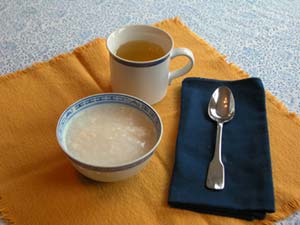
Plain Rice Porridge
Mov Kua Dis Tsuag
Makes 8 servings
A warm bowl of rice porridge is good for babies and the elderly, or when someone suffers from the flu. Not just a breakfast food, it is served whenever a person feels like it, morning, noon, or evening.
Ingredients
- 1 cup hard-grained rice, like jasmine rice
- 1 quart water
Fill a pot with 1 quart water, and add the rice to the water. Turn the heat to high. Stir often so that the rice will not stick underneath. Cook and stir for about 10 minutes. Reduce the heat to low and cook the rice until it is very soft, even mushy. Add more liquid if you like the porridge to be thin and soupy.
Translations-
Hauv Siab Oaib thiab Kaus Taum Xav-Lav(Chicken and Bean Sprout Salad)
Hauv Siab Qaib Xav-Lav yog ib yam uas tsis muaj roj, zoo noj rau txhua lub sij hawm. Ib pluag mov loj los yog thaum muaj qhua.
Khoom
Hauv Siab Qaib Xav-Lav yog ib yam uas tsis muaj roj, zoo noj rau txhua lub sij hawm. Ib pluag mov loj los yog thaum muaj qhua.
Khoom
- 1 lub hauv siab qaib muab tawv tshem
- 1 tug tauj qaib los yog tauj dub
- 4 cups kaus taum
- 4 tug dos (muab tshi kom mos txiav ua 2-inches)
- 3-4 tug zaub txhwb txiav ua 2-inches
- 3-4 tug zaub txwg theem liab (de nplooj xwb)
- 1 lub mav-naus (lemon or lime)
- Me ntsi ntsev
- Peev-nuas (MSG) optional
- 2 quarts dej
Muab ib lub lauj kaub rau dej rau, tos kom npau ces muab lub haub siab qaib tso rau, rau ib tug tauj dub kom tsw qab, rau me ntsi ntsev kom qab. Hau kom lub hauv siab qaib siav ces muab npog cia kom txias.
Do Li Cas
Muab 4 cups kaus-taum yaug dej kom huv thiab (drain) kom tsis txhob muaj dej tso rau ib lub tais plaj, muab lub hauv siab qaib ntsi kom tej tug me-me tso nrog rau cov kaus-taum, rau zaub txhwb, dos, thiab plooj zaub txwg theem liab, rau me-me ntsev, me-me pleev-nuas (optional), hwj txob, me-me naj-pam (fish sauce), thiab kua mav-naus (lime juice), muab do ua ke ces nog xwb.
 |

 | |
|
Mov kua dis yog ib yam uas peb plaj rau tej lub caij uas tsis txhuam xis neej los yog rau cov me nyuam mos uas tsis tau muaj hniav.
Khoom
- 1 cup txhuv txua yam twg los tau
- 1 quart dej
Nco ntsoov do kom tsis txhob khub qab lauj kaub. Thaum twj cov txhuv muag tag lawm ces muab hais rau ib lub tim, tshuab kom txias ces noj xwb.
Kua-Dee Nqaij(Rice Porridge with Meat)
Mov kua dis yog ib yam uas peb Hmoob ib tswm noj rau tej lub caij uas tsis txhuam xis neej los yog rau cov me nyuam mos uas tsis tau muaj hniav. Tej lub caij peb kuj ua kua-dis tsuag yam tsis rau dab tsi li, tej thaum peb tej tug kuj nyiam rau nqaij rau, ua kua-dis qab tsev.
Khoom
- 1 cup txhuv txua yam twg los tau
- 1 quart dej
- 1 tug tauj dub los yog tauj qaib (lemon grass)
- 1/2 hauv siab qaib los yog ib qho qaij npuas ntsiv tsuav kom mo-mo
- me-me ntsev
- me-me hwj txob
Muab ib lub lauj kaub rau li (1 quart) dej, rau cov txhuv rau nco ntsoov do kom tsis txhob kub qab lauj kaub. Rau ib tug tauj dub rau kom tsw qab, tos thaum cov mov muag tag lawm ces muab cov nqaij do xyaw me-me dej kom tsis txhob sib lo, muab nchuav rau hauv lub lauj kaub kua-dis, dox kom sib xyaus rau me-me ntsev thiab hwj txob rau kom qab. Thaum cov qaij siav lawm ces muab hais rau ib lub tais tim ces noj xwb.

|


.jpg)